post / 2024.05.06
A Little Note on Life
This article was last updated on 2024-05-06. Please note that the content may no longer be applicable.
Alive
There was no holiday during the May Day break. I just finished the university-level electronic design competition, and although the results weren’t great, I learned a lot.
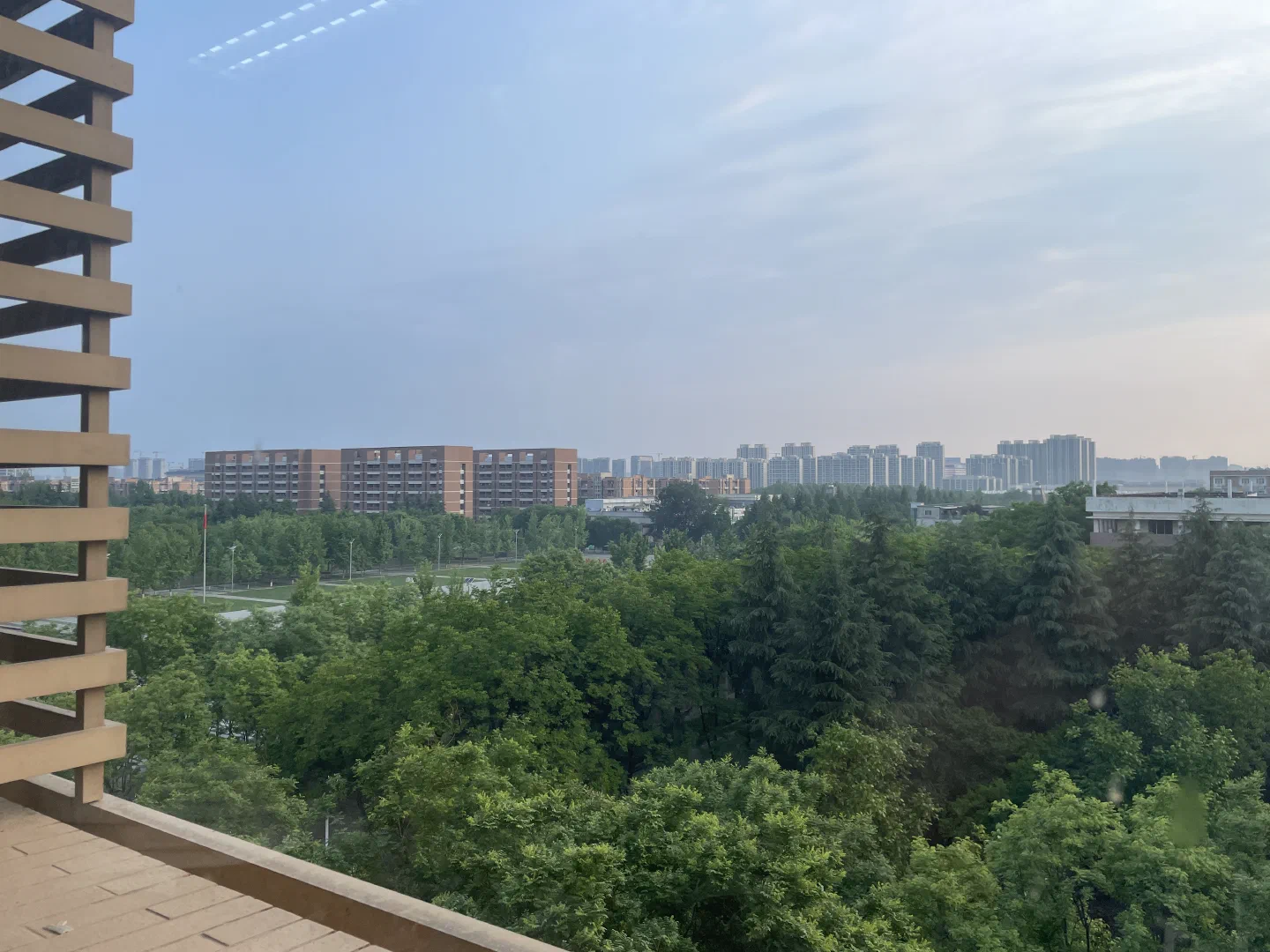
On the fourth night, I pulled an all-nighter. By five or six in the morning, the sun rose, and the few groups of students who had also stayed up all night in the lab took photos to commemorate the moment. It’s rare to see the sunrise at Xidian University. The fifth floor of Building F offers an open view, with distant high-rises and the campus greenery all bathed in the unique beauty of the morning sun and the relief of finishing work. I started sleeping yesterday afternoon and didn’t wake up until eight the next morning, ready to start a new week of classes. Though well-rested and refreshed, I still felt exhausted after a full day of lectures.
The small path to Building C was unusually beautiful today. It’s early summer—no melancholy of spring flowers withering and falling, no scorching heat or torrential rain of midsummer, just pure, pleasant weather, neither too hot nor too cold, with air quality that hasn’t hit hazardous levels (Xi’an’s AQI often exceeds 500). No flowers, just green leaves, plain yet delightful.
I envy the little grass and shrubs by the roadside, quietly curling up undisturbed. No 8:55 AM classes, no homework, no mandatory lectures or competitions—they just stand there. No one scolds the grass for lacking leaves in winter or for attracting too many mosquitoes in summer, but I’m different.
The life of grass is fragile. It dies in winter, or some bored person might step on it or yank it out. I’m different. It’s hard for me to die by accident; under normal circumstances, I’ll have to endure decades more suffering in this world. Comparatively, a life that could end at any moment but is free from hardship seems much more comfortable—no worries, every extra second is a bonus, and death doesn’t matter.
“What if you also lived in fear of death every day?”
“Then I’d cherish my time and live more passionately.”
“So you wouldn’t choose to die.”
Yes, I’m just too comfortable being alive—mediocre because I can’t die.
Philosophy
My first philosophical reflections began in middle school. Back then, I read a lot of orthodox sci-fi literature and was also obsessed with web novels (QQ Reading +笔趣阁, totaling around 2,400+ hours). I was awed by grand narratives and moved by lofty morals. I oscillated between pessimistic resignation under metaphysical materialism and reckless idealism under idealism. These were my two ways of coping with setbacks, or rather, two modes of thought. For future planning, I vaguely explored longtermism and communism, not yet clear about the distinctions—firmly believing in the importance of scientific progress while also hoping for a world where everyone lives happily, free from oppression.
Many of those thoughts, principles, and philosophies were born in the bathroom stall. In that squalid square meter, the greatest thinker strolled through his palace of philosophy, portraits of past sages hanging on the walls.
“If Qin Shi Huang had abandoned the Great Wall, how many common people would have lived better lives! The same logic applies to rockets—they drain resources that should go toward public welfare.”
“If the wall hadn’t been built 3,000 years ago, the world would have one less wonder today, and foreign invasions might have claimed even more lives.
If we don’t develop space exploration now, how will future generations judge us for sacrificing the infinite cosmos for petty short-term gains?”
In high school, I read more traditional literature, but it only refined my intellect and literary skills without sparking deeper, more fundamental reflections.
Sadly, I gradually lost the ability to read deeply. After skimming a few books on communism, I became convinced it was the way forward; watching a few progressive videos gave me a fleeting burst of motivation. In university, I rarely read poetry or books, and my writing lost its spark. The words I penned now embarrass even me. Immersed in the internet, I didn’t notice myself becoming frivolous, tainted by a hint of cynicism.
Can I still read long articles? Can I still pause to reflect while reading? I don’t know. In this era of bite-sized content, firing up Battlefield for a quick match seems more gratifying than reading. I no longer have uninterrupted time to savor a good book. The little energy I have left demands a quick hit of stimulation, not a scalding cup of tea that requires patience to cool.
Longing in Familiarity
After class in the afternoon, I walked back to my dorm under dappled sunlight. An unnamed bird hopped from the roadside to a low branch, then to a higher one as I approached. Once again, I felt the beauty of this small campus. Xidian is like a plain but enduringly attractive girl—unremarkable at first glance, even a bit dowdy. But after two years, I’ve begun to appreciate its quiet beauty, where everything is just right.
I’ve also grown accustomed to Xi’an, this western metropolis. When complaining, I call it Xi’an; when praising, I elegantly dub it Chang’an. As for the Chang’an District, it bears no resemblance to the prosperity of its namesake.
Though most Chinese megacities are nearly identical, Chang’an is still lovely. It has everything you’d expect, with street food stalls exuding warmth and a sense of “lived-in vibrancy.” Most places are clean, crowds are manageable, traffic is usually smooth, and prices are reasonable—“moderation,” Chang’an’s way of hosting guests, and also the ruler’s way of governing.
People Change
“No man ever steps in the same river twice.”
—Heraclitus
Everything changes, and I often notice how others change. Some improve (rarely), some I once admired become detestable, some unique individuals turn mundane, and most simply grow unfamiliar. From my perspective, the old world slowly morphs into something I either resent or miss, but I rarely recognize my own transformation.
During my phase of pursuing absolute morality, I was practically a saint (and also a libertine). Now, I’ve become much more “normal.” I no longer pick up every piece of trash on the street (though I might still right a toppled bike). I used to silently thank every hardworking person I saw, and I still often do. As for this “decline in moral standards,” my current self can “accept” it, and perhaps my past self would “forgive” it too.
What I can’t accept is how I’m becoming vulgar.
I once believed I was special, both in thought and action—partly due to precociousness, partly because of a teenager’s craving for attention.
Just as everyone cringes at their old QQ posts and social media updates, the cringeworthy, edgy words of youth expose our younger selves in a self-centered world where everyone is the most unique.
Yet even now, I still think the past me was special, at least unique, unlike anyone else.
Lately, though, the differences are shrinking. I see myself becoming more and more like those around me—an average student at an average university, rushing to 8 AM classes on an empty stomach, zoning out in lectures, gaming after class, scrolling the internet, or occasionally indulging in minor melancholia.
I never thought I’d remain unique forever. While others fantasized about Tsinghua or Peking University, I knew I’d end up ordinary, just like everyone else—working hard to support a family, growing rigid in thought, clinging to outdated tastes, even criticizing new trends. I’m not afraid of mediocrity; we’ll all become mediocre.
What’s terrifying isn’t mediocrity—it’s vulgarity.
Since losing everyone I could rely on last year, I’ve had no idea what to pursue.
For grand ideals and the suffering of distant strangers? These matter, of course, but they’re too far removed, both in time and space. The ideals are so vague—what can I even do? Even if I study hard and join the aerospace industry, I’ll likely just become a standardized screw, stuck in place, replaceable by anyone. What’s the meaning of my existence?
For a happy family? Clearly, no one likes me now, and chances are slim that anyone ever will. If all I need to do is support my parents and myself, graduating and earning an average salary would suffice. No marriage, no mortgage—8,000 RMB a month would leave me comfortable, even with savings. So why should I strive now?
Forgive me for being mundane, but living requires finding some meaning—otherwise, I might as well be roadside grass, ready to die at any moment. No one needs me to live for them, and I don’t crave material excess. I’ve completely lost my direction.
“Maybe slacking off isn’t so bad.” With that mindset, I’ve lost all motivation to improve. I don’t want to learn new things, not even the coursework. I go through the motions, appearing alive but devoid of vitality. I’ve become unbearably vulgar.
At least I’ve grown used to being alone—enough to keep me from dying.
During dinner, I thought about a lot, planning to write it all down for my blog. But when I opened Obsidian, I realized it wasn’t installed on my new laptop. After downloading it, tweaking settings, and fiddling with themes, I forgot what I wanted to write. All I remember is eating stir-fried potatoes with cured meat.
Perhaps life is like a plate of mediocre stir-fried potatoes with cured meat.
Therein lies the truth,
But words fail me now.
Author: 孤筝
Title: A Little Note on Life
Published: 2024-05-06
Updated: 2024-05-06
License: CC BY-NC-SA 4.0
Sponsor / I took a taxi home for sixty or seventy dollars!


When will I have a drink and discuss the details again?