post / 2023.12.27
Real Number Construction Reading Report
This article was last updated on 2023-12-27. Please note that the content may no longer be applicable.
Foundations of Real Numbers Book Report
Taking advantage of this mathematical analysis assignment, I’d like to document the construction of real numbers.
The establishment of real numbers forms part of the foundational theories in mathematics, intersecting with multiple branches such as mathematical logic, set theory, and algebraic structures. Through rigorous derivation of these fundamental concepts and properties, mathematicians have constructed the real number system, providing a solid foundation for mathematical development. This process has evolved over a long history with contributions from numerous mathematicians.
1. Book Information
1.1 Mathematical Analysis
- Author: Tom A. Apostol
- Year of Publication: 1973
- Introduction: Mathematical Analysis is a classic work by Tom M. Apostol, systematically introducing foundational knowledge in mathematical analysis, including the real number system, limits, continuity, and more. With clear logic and profound insight, the author helps readers develop a deep understanding of real numbers.
1.2 Real Analysis and Functional Analysis
- Author: Kuang Jichang
- Year of Publication: 2002
- Introduction: Real Analysis and Functional Analysis is an advanced mathematics textbook by Professor Kuang Jichang, primarily covering the basic concepts, theories, and methods of real analysis and functional analysis. A distinctive feature of this book is its integration of traditional real-variable function theory, measure theory, and functional analysis into a modern foundational course using sets and mappings.
1.3 Real and Complex Analysis
- Author: Walter Rudin
- Year of Publication: 2006
- Introduction: This book is a classic in the field of analysis. Its elegant structure and practical utility are complemented by concise and brilliant examples. Both the real and complex analysis sections rigorously prove nearly all propositions presented.
1.4 Real Analysis
- Author: Halsey Royden, Patrick Fitzpatrick
- Year of Publication: 2010
- Introduction: This book has become a classic in mathematical analysis, offering students a profound theoretical foundation. The fifth edition includes significant updates, comprehensively covering measure theory, integration theory, and topics essential for modern analysts, such as metric, topological, Hilbert, and Banach spaces.
2. The Real Number System
The real number system is the cornerstone of mathematical analysis. Apostol’s book details the definition and properties of real numbers. Key features such as completeness and density make real numbers fundamental to mathematical analysis.
The construction of real numbers involves basic mathematical concepts and systematic development. The real number system provides a complete description of quantities, including integers, rational numbers, and irrational numbers.
2.1 Introduction to Rational Numbers
Natural Numbers: The starting point is the natural numbers: 1, 2, 3, 4, …, used for counting and ordering.
Integers: To address subtraction, zero and negative integers are introduced, forming the integer system: positive integers, zero, and negative integers.
Rational Numbers: While integers solve subtraction, division remains limited. For example, calculating $\frac{1}{3}$ or $\frac{2}{7}$ reveals numbers not expressible as integers. Rational numbers extend the integer system, ensuring any ratio of two integers belongs to this new set. The rational number system addresses gaps in the integer system, ensuring density—between any two rational numbers lies another rational number.
Properties of Rational Numbers: Rational numbers are closed under addition, subtraction, multiplication, and division (except by zero). These properties make rational numbers a complete number system.
2.2 Introduction to Irrational Numbers
Limitations of Rational Numbers: Although rational numbers represent most quantities, some numbers, like $\sqrt{2}$, cannot be expressed as a ratio of integers. No integers $a$ and $b$ satisfy $\frac{a}{b} = \sqrt{2}$.
Definition of Irrational Numbers: To fill this gap, irrational numbers are introduced—numbers not expressible as ratios of integers, i.e., non-rational numbers.
Transcendental Irrational Numbers: These are irrational numbers that cannot be roots of any algebraic equation, e.g., $e$ and $\pi$. They cannot be derived through finite algebraic operations.
2.3 Proof of Real Number Completeness
The real number system is complete: any infinite sequence on the real line has a limit. This property is crucial in mathematical analysis, especially for limits, continuity, and convergence.
Methods of Proof
Supremum Principle
Definition of Supremum:
For a set $S$ of real numbers, if a real number $M$ is an upper bound of $S$ and any number less than $M$ is not an upper bound, then $M$ is the supremum of $S$.
Example:
For $S = \{ x \in \mathbb{R} \mid 0 \lt x \lt 1 \}$, the supremum is 1.
Completeness of Real Numbers:
- Monotone Convergence Theorem: A bounded monotonic sequence converges.
- Existence of Supremum: Every non-empty bounded set of real numbers has a supremum.
Monotone Convergence Theorem
A bounded monotonic (increasing or decreasing) sequence of real numbers has a limit.
Nested Interval Theorem
For a sequence of closed intervals $[a_n, b_n]$ where each interval is contained within the previous one, there exists a real number $x$ common to all intervals.
Finite Covering Theorem (Heine-Borel Theorem)
Any open cover of a closed bounded interval has a finite subcover.
Bolzano-Weierstrass Theorem
Every bounded infinite subset of real numbers has at least one accumulation point.
Cauchy Convergence Criterion
A sequence of real numbers converges if and only if it is a Cauchy sequence.
2.4 Algebraic Structure of Real Numbers
The real number system adheres to algebraic properties:
- Addition: Commutative, associative, identity element (0), and inverses.
- Multiplication: Commutative, associative, identity element (1), and inverses (for non-zero elements).
- Distributive Property: Multiplication distributes over addition.
- Order Relation: Real numbers are ordered, with properties like transitivity and antisymmetry.
These properties make real numbers an ordered field, providing robust tools for mathematical analysis.
3. Limits and Continuity
Limits and continuity are central to mathematical analysis.
3.1 Limits of Real Numbers
Definition:
A sequence $\{a_n\}$ converges to $L$ if, for any $\varepsilon \gt 0$, there exists $N$ such that for all $n \gt N$, $|a_n - L| \lt \varepsilon$.
Example:
$\lim_{n \to \infty} \frac{1}{n} = 0$.
Properties:
- Uniqueness of limits.
- Bounded monotonic sequences converge.
3.2 Continuity of Real Numbers
Definition:
A function $f(x)$ is continuous at $x = a$ if:
- $f(a)$ exists.
- $\lim_{x \to a} f(x)$ exists.
- $\lim_{x \to a} f(x) = f(a)$.
Properties:
- Sums, products, and compositions of continuous functions are continuous.
3.3 Key Theorems
Intermediate Value Theorem:
If $f$ is continuous on $[a, b]$ and $f(a) \neq f(b)$, then for any $c$ between $f(a)$ and $f(b)$, there exists $x_0 \in (a, b)$ such that $f(x_0) = c$.
Extreme Value Theorem:
A continuous function on a closed interval attains its maximum and minimum.
4. Comparative Analysis
4.1 Mathematical Analysis:
- Covers basic real analysis: construction of real numbers, continuity, limits, derivatives, and integrals.
- Emphasizes mathematical logic and set theory.
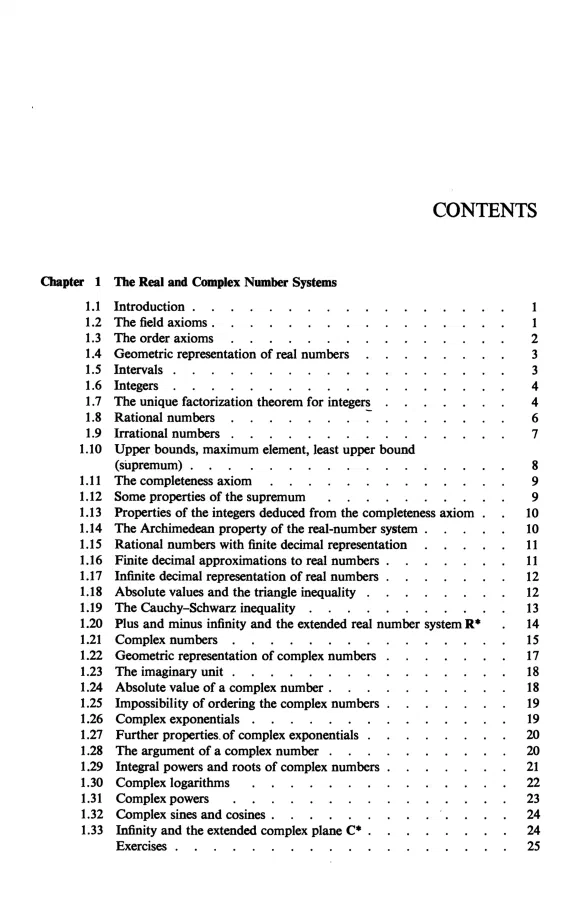
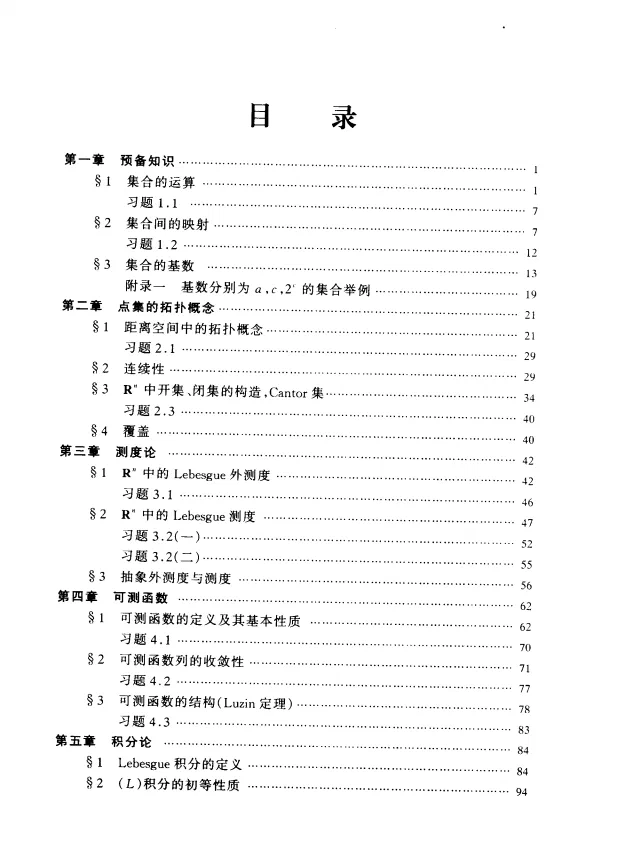
4.2 Real Analysis and Functional Analysis:
- Discusses advanced constructions like Dedekind cuts.
- Includes measure theory and functional analysis basics.
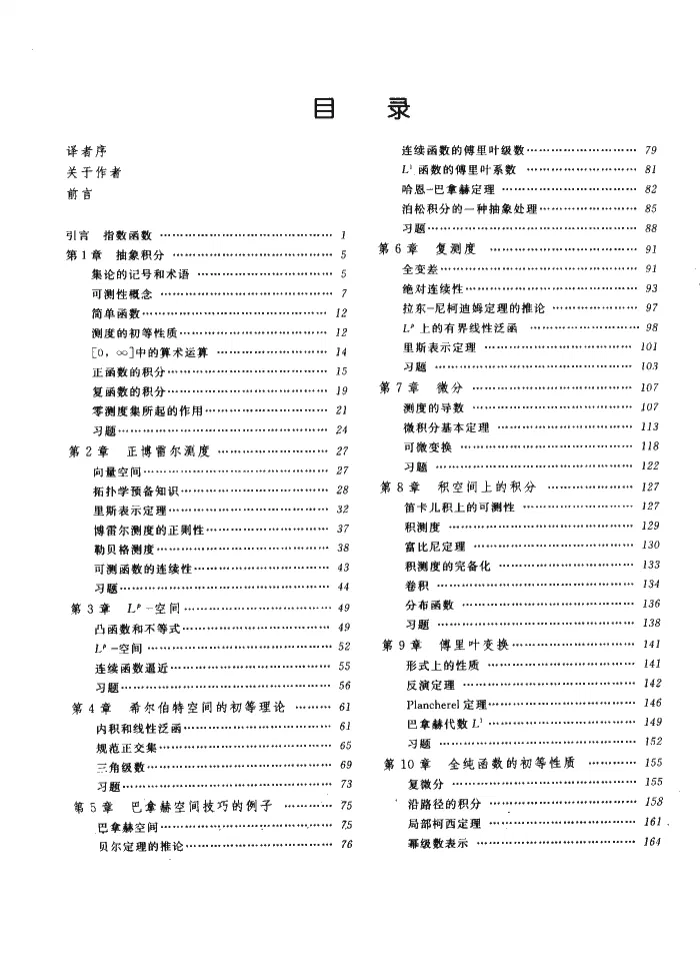
4.3 Real and Complex Analysis:
- Comprehensive coverage of real and complex analysis.
- Highlights measure theory and holomorphic functions.
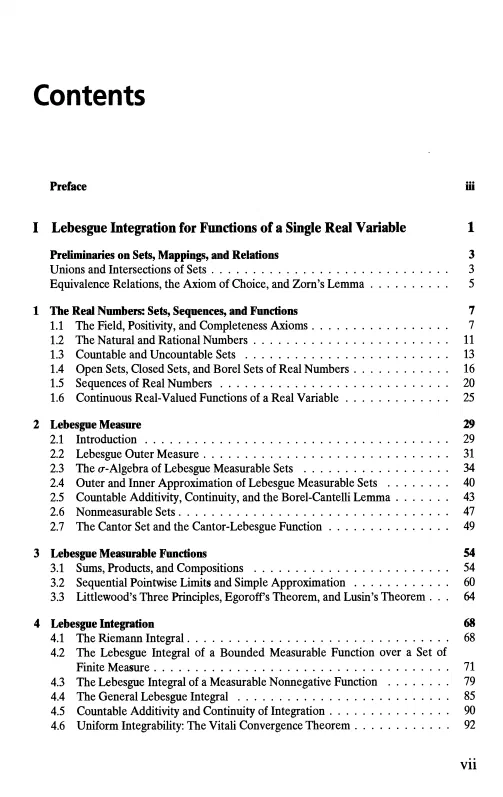
4.4 Real Analysis:
- Focuses on the real number system’s construction and completeness.
- Explores metric spaces for deeper understanding.
7. Personal Reflection
Studying the construction of real numbers has expanded my mathematical perspective. Understanding the transition from rational to irrational numbers and proofs like the supremum principle has deepened my appreciation for the completeness of real numbers.
The concepts of limits and continuity reveal a profound and elegant aspect of mathematics. Limits provide tools for analyzing trends, while continuity ensures smooth transitions in functions, forming the backbone of mathematical analysis.
Author: 孤筝
Title: Real Number Construction Reading Report
Published: 2023-12-27
Updated: 2023-12-27
License: CC BY-NC-SA 4.0
Sponsor / I took a taxi home for sixty or seventy dollars!


When will I have a drink and discuss the details again?