post / 2024.08.20
*Black Myth: Wukong* Hands-On Impressions (No Spoilers)
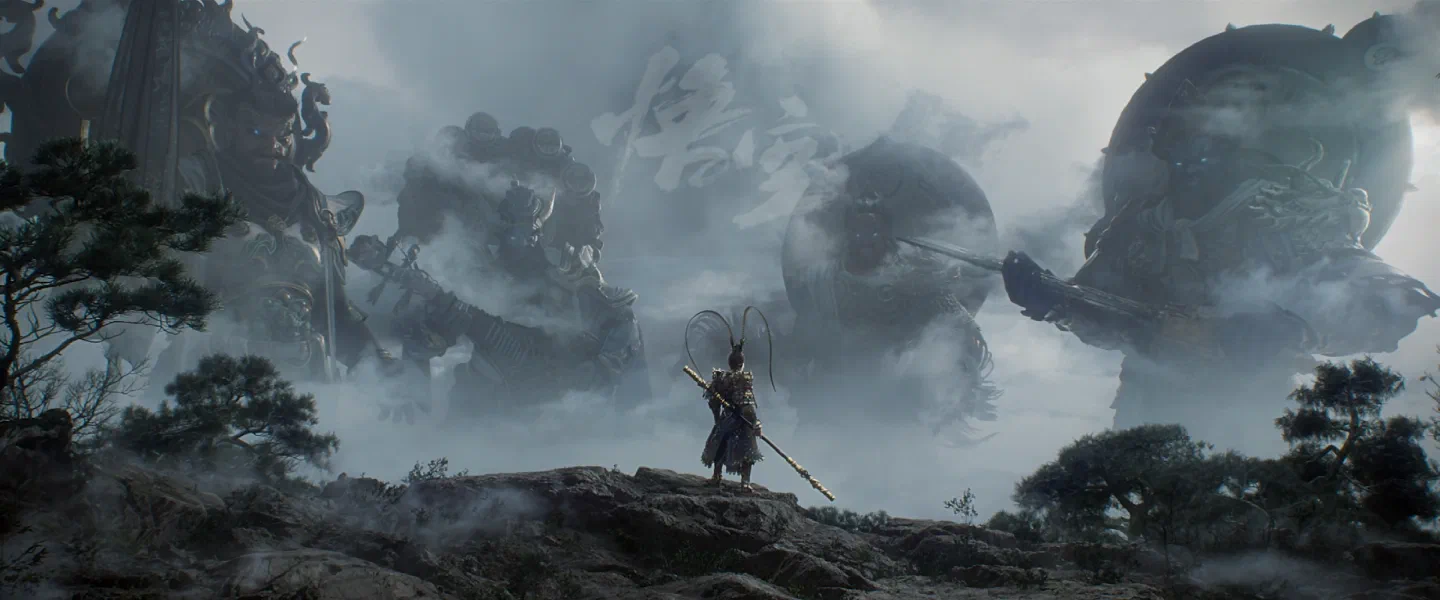
This article was last updated on 2024-08-20. Please note that the content may no longer be applicable.
“Awakening of the Wukong”
No sight of Ling Mountain, winter greys my hair,
Ninefold mists veil the sea of clouds low-hung.
Chain the heart’s ape, rein in the mind’s wild steed,
Shatter stubborn void to awaken Wukong.
Taoist trinity reforges the primal spirit,
One scripture loosens the circlet’s binding might.
Ask not how many springs lie down the road—
Ling Mountain now dwells within your sight.
(Written sleeplessly at dawn on 8.20. Revisiting it now, it’s actually quite decent.)
Objectively speaking, Black Myth: Wukong still has many bugs and optimization issues. A friend of mine with a 4060 Ti couldn’t even launch the game and was locked out for a long time.
Personally, I haven’t encountered any bugs, with only occasional stutters or frame drops (running on a 12400F + 7700XT).
About Invisible Walls
The issue of invisible walls exists, likely due to Game Science’s lack of development experience or deliberate trade-offs. Many paths that seem passable turn out to be blocked by invisible barriers. While some are marked with broken logs or small rocks, in a 3D game with jumping mechanics, it’s hard to suppress the player’s urge to explore. Given that the game is packed with hidden content, I often find myself wandering off the beaten path—only to have my enthusiasm dampened when what appears to be a traversable bamboo grove turns out to be an invisible wall.
The game is essentially a series of interconnected “box garden” levels with multiple branching paths, elevation changes, and no map. Occasionally, two paths may converge. This isn’t an open-world game, and using invisible walls instead of physical barriers to block routes can easily mislead newcomers.
About Guidance
Near Land Temple (checkpoints), there are clear light trails guiding the way. For mainline bosses, torches are placed along the path as markers. In fact, the Land God hints early on to “follow the torches,” but this tip is easily overlooked, leading to confusion.
Without a map, it’s easy to get lost, especially in the first forested area where everything looks the same, and cave entrances are poorly lit. After defeating Guangzhi, I spent half an hour searching before finding Lingxuzi.
About the Map
Sometimes I wonder if a map would solve these frustrations. But for this kind of interconnected level design, knowing the layout in advance might spoil the surprises (every path leads to a boss, treasure, or other rewards). Perhaps a blank map that fills in as you explore could work—it doesn’t need to be permanently displayed in the corner but could be accessed via settings or the Land Temple.
About Lock-On
The current lock-on system is already well-implemented. One area for improvement is when bosses perform fast, wide-ranging attacks that pull the camera too abruptly. Some boss moves break the lock-on, forcing you to re-lock manually—a potentially fatal distraction in high-stakes combat. For example, Tiger Vanguard’s feint into a heavy punch often breaks lock-on. While the punch is easy to dodge, reacquiring the target is mentally taxing, and a follow-up slash from off-screen can cost you half your health.
I’m currently stuck on Tiger Vanguard, having lost dozens of monkey heads to his liquor (Git gud).
Final Thoughts
This is a flawed masterpiece, but based on what I’ve experienced so far, it easily deserves a score above 90—even without accounting for cultural or nostalgic bonuses.
I’d give it 100 points because it’s a unique source of pride and romance for the Chinese people. Foreign players will understand it—or they’ll learn to.
I believe the more national it is, the more universal it becomes.
Game Science has delivered a satisfying answer to players and themselves—Black Myth: Wukong isn’t perfect, but it stands as China’s first true AAA title and lives up to the four years of anticipation.
Keep moving forward. The journey itself matters more than reaching Ling Mountain.
Author: 孤筝
Title: *Black Myth: Wukong* Hands-On Impressions (No Spoilers)
Published: 2024-08-20
Updated: 2024-08-20
License: CC BY-NC-SA 4.0
Sponsor / I took a taxi home for sixty or seventy dollars!


When will I have a drink and discuss the details again?